.png)
The goal of langgraph-hierarchies is to make deep, stateful agent hierarchies on LangGraph decomposable. Flat supervisor handoffs and harness-style subagents are a good starting point; this library targets the wall beyond that — recursive trees where subagents are real compiled subgraphs, with explicit policy for how parent and child state interact when a subchain starts, runs, and exits.
In summary, langgraph-hierarchies is an open-source Python library for production-grade nested agents: declarative state isolation, supervisor-controlled iteration limits, and phased compilation — not ephemeral task-tool isolation alone.
I'm building it around:
This project is particularly interesting to me because it generalises problems I've hit building multi-agent systems in production — especially complex agent hierarchy, accountability across nested runs, and keeping subgraph state predictable when depth goes past one supervisor layer. Early development (0.0.x); v0.1 will ship the keystone slice. Not affiliated with LangChain or the LangGraph team.
If you're building LangGraph agents that need more than flat delegation — nested teams, isolated subchains, and explicit state policy — you can install it from PyPI or browse the source and examples on GitHub.
Docs: link
Repo: link
Also available on PyPI: pip install langgraph-hierarchies
Tech stack:
[ Python ] [ LangGraph ] [ uv ] [ pytest ] [ ruff ] [ GHA ]
Project link:
Navigator is an application that aims at providing high-quality pentesting service for companies that can't purchase a specialised penetration tests. By automating selected section of the OWASP Top 10 (2025) classification we reduce costs and provide our customers with complex support, guiding them from detection of vulnerabilities and weaknesses in application design (OWASP A06: Insecure Design) verifying their deployment pipeline (OWASP A08: Software or Data Integrity Failures), examining the attack surface for most common vulnerabilities through explaining the nature of vulnerabilities and offering guidance in fixing and re-testing them.
In summary, Navigator offers affordable autonomous pentest teams at fraction of price and with expanded capabilities compared to traditional scanners.
This project is for me particularly interesting because I have an opportunity to tackle such operational issues as:
You can see Navigator in action here:
Tech stack:
[ Python ] [ TypeScript ] [ LangChain ] [ LangGraph ] [ LangSmith ] [ BrowserUse ] [ OpenHands ] [ Prometheus/Grafana ]
[ AWS ] [ openrouter.ai ] [ HF TGI ] [ HF TRL/SFT ] [ GHA ] [ Terraform ] [ Docker ]
Project link:
The goal of the Toshokan project is to aid English-speaking students in learning Japanese language. In my experience on the path to learn Japanese I realised that there are many obstacles that I haven't come across learning e.g., English or Portuguese. For example:
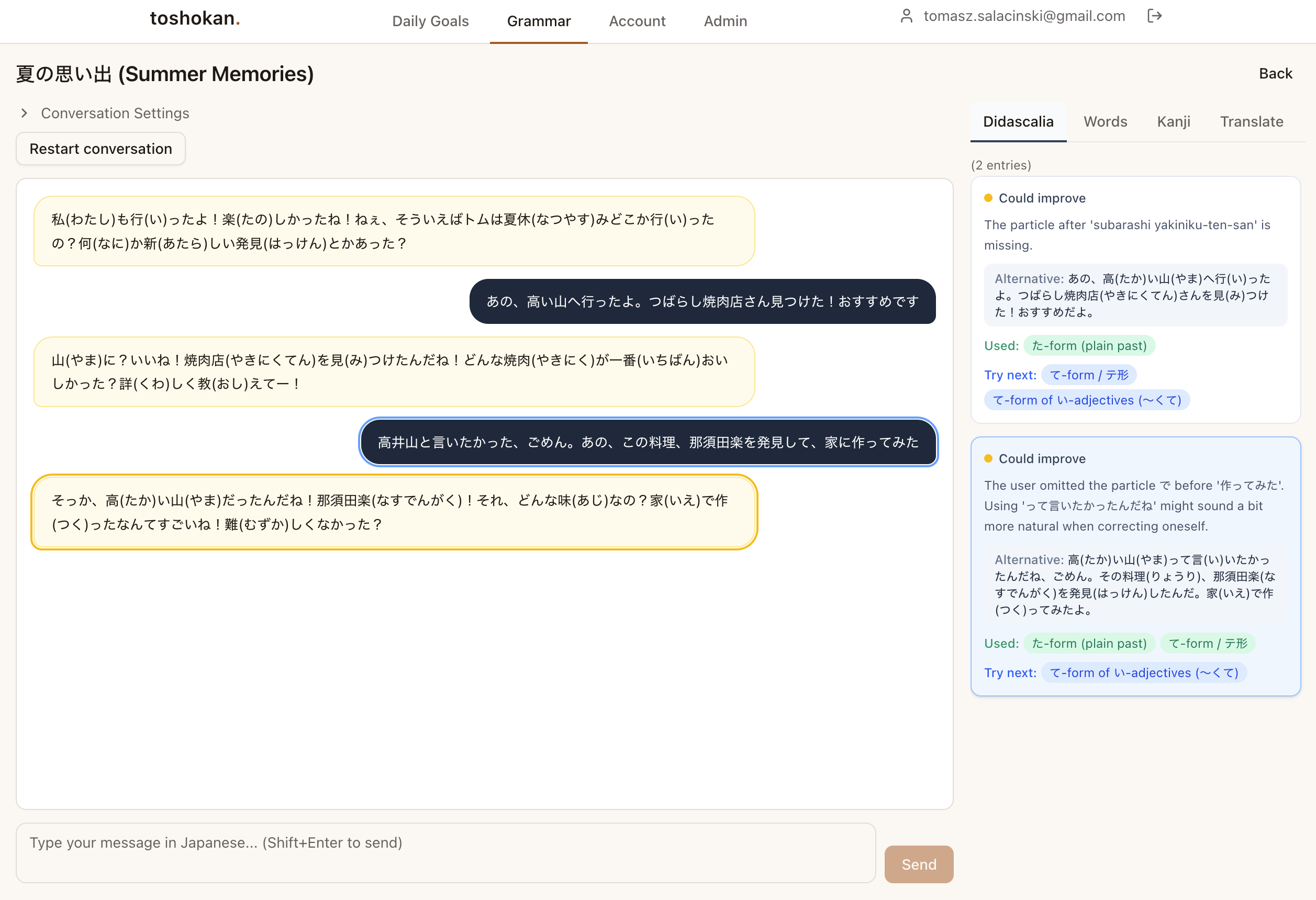
In Toshokan I attempted to harness capabilities of contemporary LLMs to remove these barriers. I'm doing so by:
If you're an Japanase N4-N2 level student, I think you might find it useful. Feel free to check it out here and let me know your thoughts!
Tech stack:
[ Python ] [ TypeScript ] [ LangChain ] [ LangSmith ] [ LangGraph ] [ openrouter.ai ] [ Supabase ]
[ Render.com ] [ Vercel ] [ GHA ] [ Docker ]
Project link: